HVAC manufacturers producing insulated panels, access doors, air handling unit components, rooftop unit panels, equipment enclosures, and other polyurethane-foamed products need precise control over product movement while foam expands and cures.
The polyurethane foaming reaction generates heat and expanding gases, which create pressure against the surrounding surfaces. Without proper support and restraint, panels can bow, warp, shift, or lose dimensional consistency. In HVAC manufacturing, those issues go beyond appearance or ease of assembly. Panel flatness, insulation consistency, sealing surfaces, and dimensional accuracy can affect the performance characteristics of the finished HVAC equipment.
Air handling unit panels present particularly demanding requirements. Foam expansion pressure acts across the full face of the panel, and any deflection that occurs during foaming is permanent once the foam cures. Those panels are then assembled into casings that carry dimensional and performance requirements of their own, so flatness at the foaming stage matters well beyond appearance. Many high-performance double-wall casings use thermal-break construction around the perimeter to limit thermal bridging and reduce the potential for exterior condensation. Consistent foam fill supports thermal performance, while dimensional consistency around gasket and sealing surfaces contributes to controlling air leakage.
HVAC production also tends to involve a high mix of panel dimensions because custom and semi-custom air handling units are modular and frequently configured around individual projects. Rooftop equipment adds another consideration because panels must perform through outdoor exposure and repeated thermal cycling.
As the leading U.S. specialist in custom urethane foaming fixtures, presses, and clamp systems, Con-Tek Machine, a Minnesota-based manufacturer with more than 40 years of experience, designs and builds engineered-to-order equipment around each customer’s product, process, workflow, and production goals.
For HVAC panel production, three requirements shape the foaming equipment: facings or platens that hold the panel to its intended geometry, structural rigidity that limits deflection under foam pressure, and thermal control when the foam process requires it. The equipment must deliver those conditions consistently, cycle after cycle, over years of production.

Polyurethane Foaming Equipment for HVAC Products
We design and build foaming equipment for HVAC manufacturers producing:
- Air handling unit panels
- Rooftop unit panels
- Insulated enclosure panels
- Access panels and doors
- Equipment doors
- Enclosed insulated assemblies
- Related polyurethane-foamed HVAC components
Our equipment ranges from straightforward manual fixtures to advanced systems with controls, heating and cooling, automation, and production-line integration. Each system is designed around the HVAC product and manufacturing process rather than adapting a standard machine to fit the application.
Why HVAC Panel Foaming Requires Precise Process Control
Large, flat HVAC products require broad, controlled support while polyurethane foam expands inside the panel. For air handling unit panels, rooftop unit panels, enclosure panels, access panels, and equipment doors, the foaming fixture or press restrains the product and maintains its intended geometry throughout the foaming and cure cycle.
Several characteristics make HVAC panel production particularly demanding.
Panel deflection
Foam expansion generates pressure across the entire panel face. If the press does not hold the panel flat through expansion and cure, that deflection is locked into the finished panel. Those panels are assembled into casings with their own dimensional and performance requirements, so restraint during foaming is more than a cosmetic concern.
Double-wall construction and thermal breaks
Air handling unit panels commonly use double-wall construction, with polyurethane foam between metal skins. Many high-performance casings use a perimeter thermal break to limit thermal bridging and reduce the potential for condensation on exterior surfaces.
Foam consistency and thermal performance
The polyurethane core contributes directly to the insulating performance of the panel. Voids, incomplete fill, or foam outside the specified process window create localized thermal defects and reduce the insulating performance of the panel.
Sealing surfaces and air leakage
Air leakage matters in HVAC equipment. Access doors and removable panels depend on consistent gasket and sealing surfaces, making dimensional accuracy especially important where panels interface with gaskets, frames, and adjoining components.
High-mix production and rooftop applications
Custom and semi-custom air handling units are modular and frequently manufactured to project-specific requirements, which can create a high mix of panel dimensions rather than a small number of repeating SKUs. Rooftop equipment also operates through outdoor exposure and thermal cycling, adding to the durability requirements of the finished panel.
What an HVAC Panel Foaming Press Has to Control
Regardless of the level of automation, an HVAC panel foaming press has three core design responsibilities.
Control product geometry. The facings or platens that restrain the panel hold it to its intended geometry during foam expansion, within the flatness tolerance the product requires.
Provide thermal control when the process requires it. Heating and cooling systems maintain the thermal conditions the polyurethane foaming process calls for.
Resist foam pressure. The press structure must have enough rigidity to limit platen deflection to the allowable tolerance as the foam expands.
These requirements have to remain consistent over repeated production cycles. Con-Tek designs the press structure, facings, thermal system, controls, and supporting equipment around those requirements.
Depending on the application, an HVAC foaming system can also include:
- Product-specific support and tooling
- Multi-cavity configurations
- PLC-based controls and sequencing
- Fully interlocked safety systems
- Self-contained heating and cooling
- Facing temperature monitoring
- Non-stick-coated facings
- Manual or automated product changeover
- Dispensing-system interfaces
- Stand-alone or production-line-integrated configurations
- Automated operator access platforms
- Product handling and recirculation
Each feature addresses a defined production requirement such as thermal control, consistency, safety, flexibility, maintenance, or integration.
Quick-change facings, when included, reduce the time required for facing replacement and service. They are a maintenance feature rather than a process-control feature.
HVAC Panel Presses for High-Mix Production
Because HVAC manufacturers often produce many panel dimensions and configurations, equipment flexibility has to be considered alongside cycle time and panel quality.
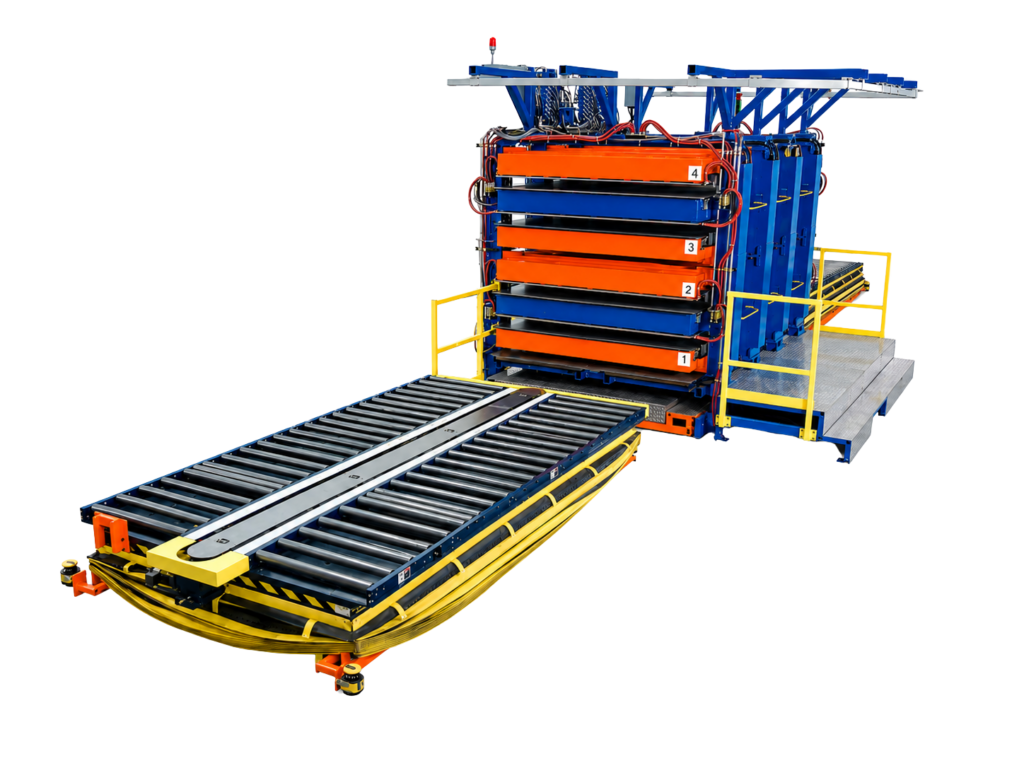
Con-Tek evaluates the complete product family rather than designing around a single panel size. Depending on the application, a press can accommodate multiple panel sizes, multiple cavities, automated sequencing, operator-access requirements, and future production expansion.
The goal is to provide the flexibility required for a high-mix environment while maintaining consistent restraint, temperature control, and repeatability through every foaming cycle.
Con-Tek HVAC Panel Press Projects
Con-Tek has designed and built HVAC panel foaming equipment around specific production, quality, and operator requirements.
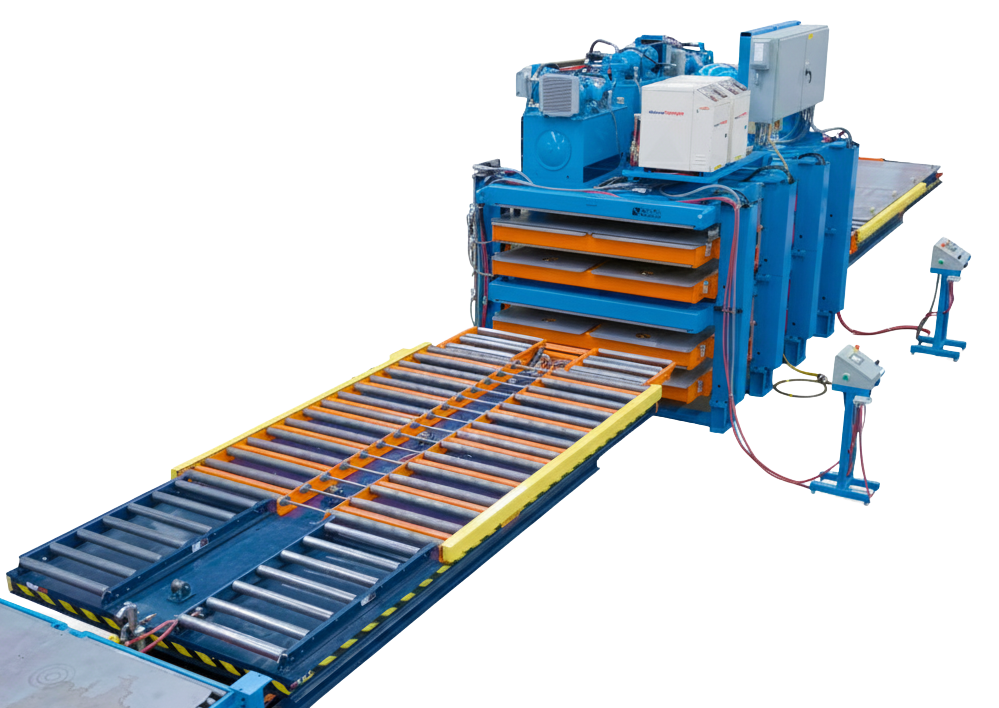
One project included a 4-cavity HVAC panel press with automated operator platforms, facing temperature monitoring, quick change facings, and non-stick-coated facings.
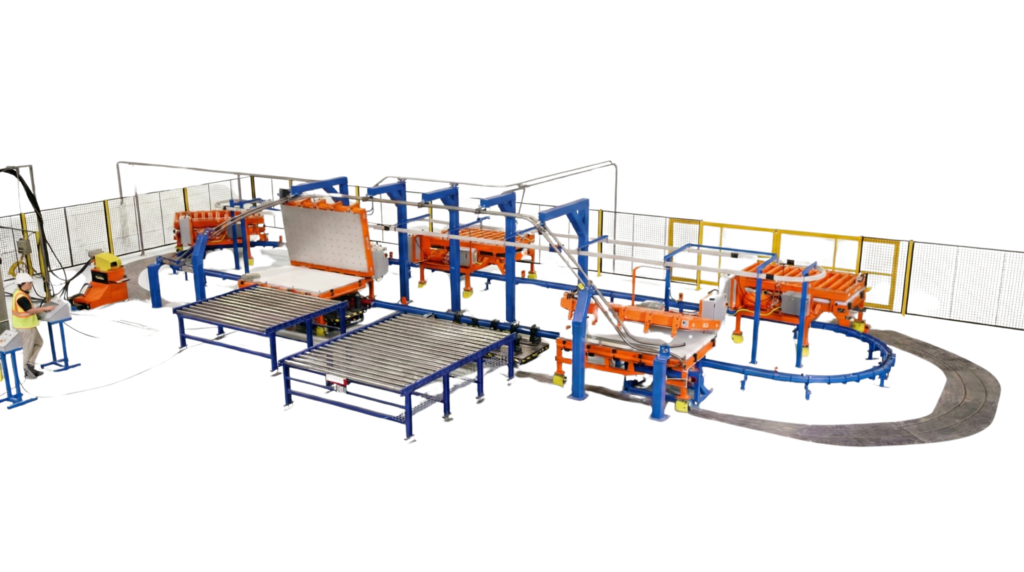
Another project involved an automated 10-module panel press for discontinuous HVAC panel production. The system was designed to produce a panel every 2 minutes and 30 seconds, accommodate multiple panel sizes, and scale production capacity based on demand.
These projects demonstrate how panel dimensions, production mix, cycle requirements, operator access, temperature control, automation, and capacity influence the final system architecture.
Designing Around the HVAC Product and Manufacturing Process
Our engineering process starts with understanding the product and how it moves through production.
Important design inputs include:
- Panel or enclosure dimensions
- Product geometry and construction
- Skin or facing materials
- Thermal-break and edge conditions
- Polyurethane foam process
- Required support locations
- Loading and unloading method
- Production volume and cycle requirements
- Heating, cooling, and facing temperature requirements
- Product models and size ranges
- Changeover expectations
- Plant layout and existing conveyance
- Dispensing equipment
- Automation requirements
- Operator access
- Safety requirements
These factors determine the fixture architecture, structural requirements, tooling, controls, thermal system, and overall system configuration.
A finished machine specification is not required to begin. Product drawings, production goals, foam-process requirements, current quality concerns, and information about the existing manufacturing process provide a starting point for evaluating the appropriate equipment.
Not every HVAC product is a flat panel. Enclosed or cabinet-style assemblies may require support across multiple surfaces or around more complex internal geometry.
For these products, Con-Tek evaluates whether a cabinet foaming fixture is more appropriate. Panel fixtures are designed primarily for large, flat products, while cabinet fixtures support enclosed assemblies across multiple surfaces.
When to Evaluate a New HVAC Foaming Fixture or Press
HVAC manufacturers should evaluate new foaming equipment when the current process no longer supports product quality, production capacity, product mix, or operator workflow.
Common indicators include:
- Bowed or distorted panels
- Inconsistent dimensions or sealing surfaces
- Surface defects
- Scrap or rework
- Difficult loading and unloading
- Slow product changeovers
- Inconsistent production cycles
- Capacity limitations
- New panel sizes or configurations
- New automation or integration requirements
- Operator-access or safety concerns
When these problems originate in the foaming fixture or the handling process, changes to restraint, thermal control, or handling address the cause during foaming rather than later during assembly or inspection.
FAQ: HVAC Polyurethane Foaming Equipment
An HVAC panel foaming press must hold the panel to its intended geometry, limit platen deflection under polyurethane foam pressure, and provide thermal control when the foam process requires it. The equipment must maintain those conditions consistently over repeated production cycles.
Con-Tek Machine evaluates panel geometry, dimensions, support requirements, production volume, cycle requirements, and changeover needs to determine how multiple HVAC panel sizes can be accommodated within a foaming system.
Panel flatness affects more than appearance. Foam expansion pressure will deflect a panel that is not properly restrained, and that deflection is permanent once the foam cures. Finished panels are assembled into casings that carry dimensional and performance requirements, so flatness at the foaming stage affects the finished equipment. Dimensional consistency is also important at gasket and sealing surfaces used to control air leakage.
Con-Tek Machine incorporates heating and cooling when temperature control is required by the polyurethane foaming process. The foam process, product construction, facing materials, panel dimensions, and cycle requirements determine the appropriate thermal-control approach.
Con-Tek Machine designs and builds automated HVAC panel foaming systems when production requirements call for automation. Systems can incorporate PLC-based controls, automatic sequencing, operator-access equipment, temperature monitoring, multi-module configurations, product handling, transfer sheet recirculation and integration with other production equipment.
Con-Tek Machine can design HVAC foaming equipment to interface with existing polyurethane dispensing systems, conveyance, and production-line equipment. Identifying those interfaces early helps determine the controls, equipment layout, loading strategy, and overall system configuration.
Custom HVAC Foaming Equipment Built Around the Product
The right polyurethane foaming equipment depends on what is being manufactured, the performance requirements of the finished HVAC product, and how that product moves through production.
If you produce air handling unit panels, rooftop unit panels, equipment doors, enclosures, or other polyurethane-foamed HVAC products, we can evaluate the product geometry, foaming process, product mix, workflow, and production requirements to determine the appropriate equipment approach.
Bring us your product drawings, process requirements, and production goals. We can determine the fixture, press, tooling, controls, thermal system, and system configuration that fit your HVAC manufacturing application.